When Can I Start Giving Protein to My Baby? India December 2025
For any new parent in India, questions about nutrition—specifically the timing of introducing key nutrients—are a major source of concern. Protein, the essential “building block” for your infant’s rapid neurological and physical growth, is often the subject of this concern.
🚀 Click here For Protein for Babies: that is 100% safe yet effective.
The good news is that your baby has been consuming the perfect form of protein since birth. The confusion typically lies in the transition from liquid nutrition to solid foods.
Based on strict guidelines from the Indian Academy of Pediatrics (IAP) and the World Health Organization (WHO), the definitive answer is split into two phases:
- Protein from Milk: Starts immediately at birth.
- Protein from Solids: Starts at 6 completed months of age.
The year 2025 reinforces the medical community’s commitment to this 6-month standard, emphasizing that starting solids earlier carries unnecessary risks.
Phase 1: Protein from Birth to 6 Months (Milk Only) | When Can I Start Giving Protein to My Baby?
Every newborn begins consuming protein immediately. During this crucial first half-year, the protein source must be highly digestible and perfectly balanced for the baby’s immature systems. When Can I Start Giving Protein to My Baby?
The Ideal Protein Source
- Breast Milk: This is the gold standard. Breast milk contains whey (easy to digest) and casein (slower digestion) proteins in an ideal ratio that changes over the course of lactation to meet the baby’s precise needs. It also contains protective antibodies and growth factors essential for gut maturation.
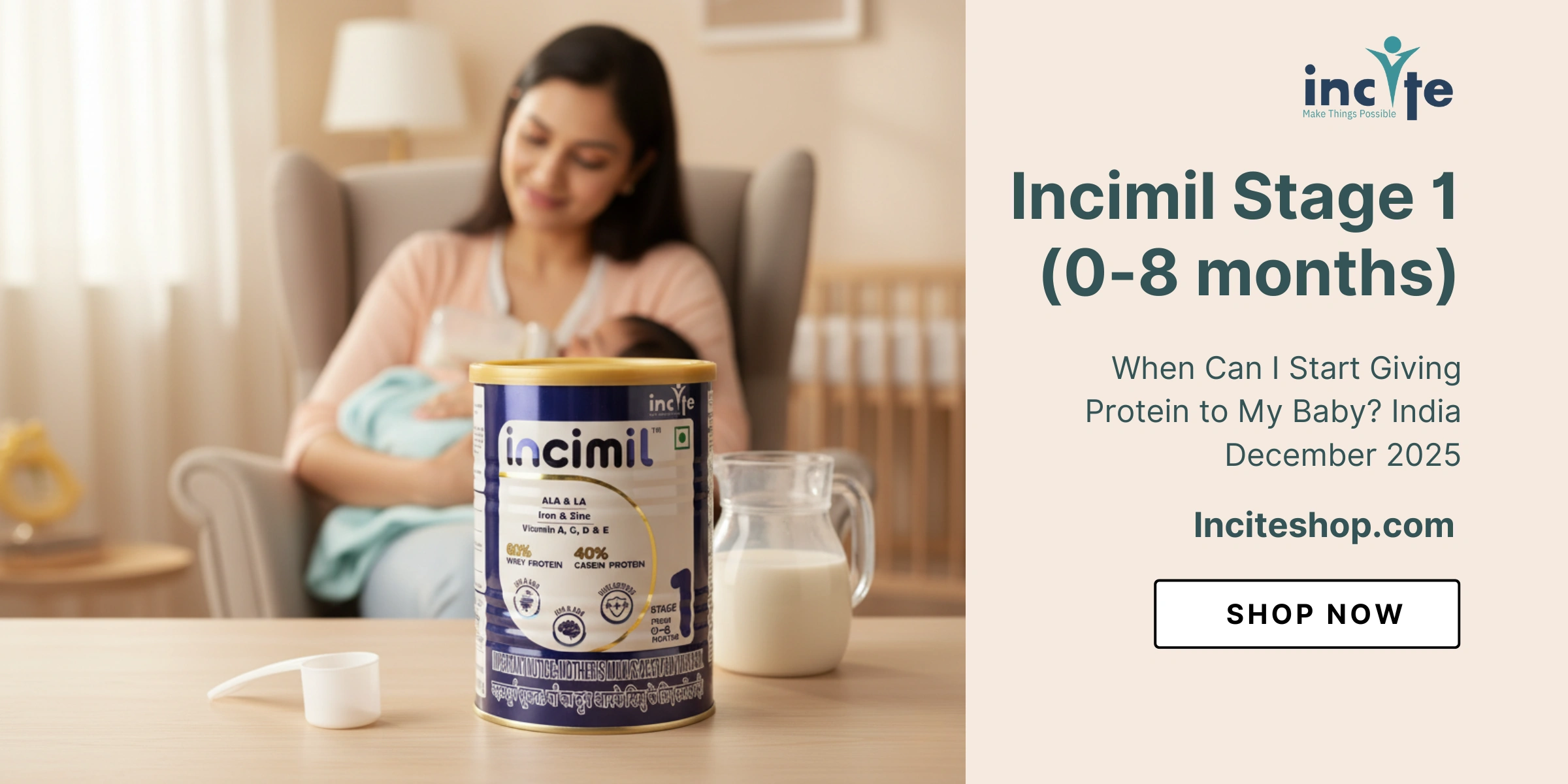
- Formula: If breastfeeding is not possible, a scientifically formulated and complete nutritional product is required. This ensures the baby receives adequate, balanced protein for their age without putting undue strain on the developing kidneys. A high-quality infant formula, like [Our website’s Infant Formula] (found here: [https://inciteshop.com/product/incimil-stage-1/]), is designed to mimic the protein ratios and nutrient balance necessary for this stage.
Why Wait to Introduce Solids? Giving protein from sources other than milk before 6 months risks:
- Gut Immaturity: The baby’s intestinal lining is not yet developed enough to handle complex proteins, potentially increasing the risk of allergies.
- Renal Solute Load: High, dense protein sources (like pulses or cow’s milk) create excess metabolic waste, overwhelming the infant’s immature kidneys.
- Choking Risk: Lack of head and neck control makes safe swallowing impossible.
Phase 2: Starting Protein Solids—The Definitive 6-Month Mark
The consensus among pediatric experts is firm: complementary feeding, including protein solids, must start only after the baby has completed 6 months of age. When Can I Start Giving Protein to My Baby?
Why 6 Months is the Optimal Timing (Biological Readiness)
The 6-month mark is not an arbitrary date; it aligns with several biological milestones that ensure safety and nutritional necessity:
- Iron Depletion: By 6 months, the iron stores built up during the baby’s time in the womb are significantly depleted. Since milk (breast or formula) does not provide sufficient iron after this point, the baby needs iron-rich solid foods—many of which are excellent protein sources (e.g., pulses, eggs, meats).
- Gut Maturation: The digestive system has developed enough to produce the necessary enzymes to break down complex carbohydrate and protein chains found in solids.
- Immune System: The gut’s immune barrier is better developed, helping to minimize adverse reactions and allergies upon the introduction of new foods.
Physical Signs Your Baby is Ready for Solids | When Can I Start Giving Protein to My Baby?
While the calendar is key, your baby should also demonstrate physical readiness before starting any solids:
- Head Control: The baby can hold their head up in a steady, upright position.
- Sitting Support: The baby can sit upright, often with minimal assistance (necessary for safe swallowing).
- Loss of Tongue-Thrust Reflex: The infant stops automatically pushing food out of their mouth with their tongue.
- Chewing Motion: The baby makes chewing or biting motions.
- Interest in Food: The baby watches others eat and may reach for food.
The Indian Introduction Strategy: What Protein to Start With
Once the 6-month timing is reached, the “how-to” and “what-to-start-with” are crucial to maximizing protein absorption and acceptance.
Initial Proteins (6–8 Months): Pulses and Dairy
The first sources of protein must be easily digestible and presented in a smooth, liquid consistency. When Can I Start Giving Protein to My Baby?
- Pulses (Dal): Moong Dal (split yellow lentils) or Masoor Dal (red lentils) are ideal starters in India. They should be pressure-cooked until very soft, mashed completely, and diluted with breast milk or vegetable stock to a smooth, flowing consistency. This provides both plant-based protein and fiber. Start with 1 to 2 teaspoons once a day.
- Dairy: Plain, unsweetened yogurt (dahi/curd) made from full-fat milk is an excellent protein and calcium source. The culturing process makes the proteins easier to digest than the proteins in cow’s milk itself.
- The 3-Day Rule: Introduce each new protein source alone and wait 3 days before introducing the next. This allows you to easily identify any allergies or intolerances.
Advancing Textures (8–12 Months): Complex Proteins | When Can I Start Giving Protein to My Baby?
After 8 months, the amount of protein given needs to increase. Foods should be mashed or minced, not just puréed, to encourage chewing development.
- Eggs: The egg yolk is often introduced first (rich in protein, iron, and choline). Once the yolk is tolerated, the entire hard-boiled, mashed egg can be given (egg white is a more potent allergen and should be introduced carefully).
- Paneer: Homemade paneer (cottage cheese), cut into very small, soft cubes, is a great finger food and a source of quality protein and fat.
- Mixed Proteins (Khichdi): Combining rice with pulses (like Moong Dal Khichdi) creates a complete protein, meaning it provides all the essential amino acids the baby needs.
- Animal Protein: Well-cooked, finely shredded chicken or boneless, mild fish (e.g., sole, pomfret) can be introduced. These are the best sources of highly absorbable heme iron, essential for boosting the baby’s immune system and red blood cell production.
Safety & Timing Exceptions (Preterm Babies and Deficiencies)
While 6 months is the standard, two exceptions require specialized medical timing, highlighting the necessity of E-E-A-T.
A. Preterm and VLBW Babies | When Can I Start Giving Protein to My Baby?
For babies born prematurely or with Very Low Birth Weight (VLBW), the nutritional clock runs differently. They have higher protein and calorie needs immediately after birth and often require fortification of human milk (Human Milk Fortifier or HMF) starting much earlier than 6 months (often around 1-3 weeks postnatal age) to achieve catch-up growth.
Consultation: In these cases, the timing and type of protein (HMF, specialized formula) are managed strictly by a neonatologist.
B. Confirmed Deficiencies | When Can I Start Giving Protein to My Baby?
If a baby is diagnosed with Failure to Thrive (FTT) or Severe Acute Malnutrition (SAM), a pediatrician or clinical dietician may prescribe specialized therapeutic foods or supplements at an earlier or unconventional time. This is always done under a strict medical protocol to manage the risks of refeeding syndrome and kidney strain.
Read a similar article on “Age-Appropriate Nutrition Introduction for Infants (India 2025)”
Frequently Asked Questions (FAQs) | When Can I Start Giving Protein to My Baby?
Q1. Can I start giving protein (dal) at 4 months if my baby seems hungry?
A. No. Pediatric guidelines strongly recommend waiting until 6 completed months. While your baby may seem hungry, increasing the frequency or volume of breast milk or formula is the correct response. Introducing dal or other solids earlier can harm the baby’s gut and may displace milk calories, actually reducing overall nutritional intake.
Q2. How much protein does my 7-month-old need per day?
A. An average 7-month-old needs approximately 9 to 10 grams of protein per day. This amount must come primarily from breast milk/formula, with the remaining $3 \text{ to } 4 \text{ grams}$ coming from solid foods like mashed dal, yogurt, egg yolk, or mashed paneer.
Q3. Is the protein in cow’s milk safe for a baby under 1 year?
A. No. Cow’s milk should not be used as the primary beverage. Its protein structure and high mineral content are too harsh for the infant’s kidneys (high Renal Solute Load). However, cultured dairy products like yogurt and paneer are generally safe when introduced in moderation after 6-8 months.
Q4. When can I stop breast milk/formula and switch entirely to solids?
A. Never. Breast milk or formula remains the primary source of nutrition until the baby is 12 months old. Solids are complementary. After the first birthday, you can transition to whole cow’s milk and a full family diet.
How to Give Protein to an Infant? India December 2025
Protein is the crucial “building block” nutrient for a baby’s rapid development, essential for cell repair, muscle formation, and neurological growth. For parents in India, finding the right way to introduce and maintain adequate protein can be a source of confusion, especially when navigating cultural foods and modern dietary advice. The strategy for providing protein to an infant is defined by age and physiological readiness. According to current Indian pediatric guidelines, the process is divided into two distinct, non-negotiable phases. Read more…
Conclusion For When Can I Start Giving Protein to My Baby?
The question, “When can I start giving protein to my baby?” has a clear answer supported by decades of nutritional science in India: at birth via milk, and at 6 completed months via solid foods.
This phased approach ensures that your baby’s delicate system is protected while meeting the accelerating demands of their growth. By following the IAP’s 6-month rule, monitoring for signs of readiness, and prioritizing nutrient-dense Indian foods like well-cooked pulses, you set a strong, healthy foundation for your child.